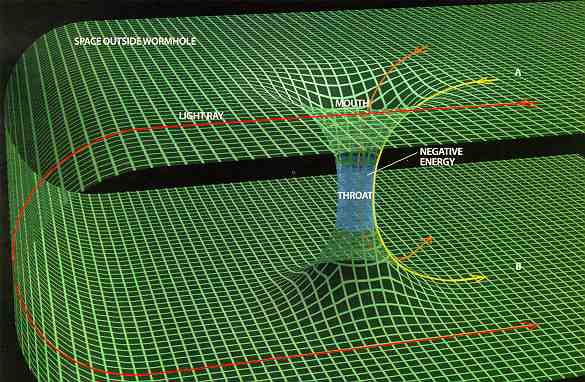
Time Machines: Part Two

Last week I talked about some time machines from science fiction and what I would do if I had access to one. Today I'll discuss how likely they are to get me to my time-travelling goals. I've compiled a list based on my own limited knowledge of physics (two college courses and abuncha books). This list is not designed to incur the wrath of Stephen Hawking (who possibly reads my blog), Bill Nye the Science Guy, or Sheldon from The Big Bang Theory. However, if after reading this blog you disagree with me, you should feel free to tell me so in the comments section as long as you post as one of the aforementioned.

That being said, the list below is ranked on probability (as I understand it) in order from least to most likely:

6. The time machine from Napoleon Dynamite: I loved this time machine because it was ridiculously simple, and you can get it online (theoretically). However it didn't work—not even in the movie, so I'm rating it as the least likely time machine to work as intended and the most likely time machine to shock your junk in a non-sexy way.
Time Machine from Napoleon Dynamite
(photo credit: Emergiblog)

5. H.G. Wells' time machine: It's been a while since I read this book, but as I remember it, this machine was designed to arrive at the same point in space, regardless of the time. Perhaps H.G. forgot to take the movement of the planet into consideration and his unsuspecting time traveler should have materialized somewhere out in space, albeit in a different time, attempting to shout "Eureka" in a vacuum for 30-60 seconds until his fluids boiled. Although this would allow me to time travel, I don't believe I would have enough time to affect any significant change before I ceased to exist.
H.G. Well's Time Machine
(photo credit: IGN)

4.The flux capacitor: I have no evidence that this machine works, except that Doc Brown said it did, but I've provided a link to a website that explains it for those of you who are curious. Still, it seems like the classiest of all the time machines—as it is housed in a DeLorean.
The Flux Capacitor
(photo credit: Futurepedia)

3. John Titor's time machine: I've rated this one of the more likely to work, simply because I'd really like to believe that some guy traveled back in time and spent his time posting on message boards about the future and was obliging enough to include the schematics of this time machine. John Titor no longer posts online, either because he went back to the future, or he was really a pimply-faced kid who grew up and got tired of his wife yelling at him every time he tried to post. ("I'm not looking at porn, Angela. I'm preserving the world for our children. (Side note: I've decided that his wife's name is probably Angela.)) Sure, I know his posts didn't come true exactly the way he said they would, but that's because in telling us, he created a paradox, which a) altered the future or b) split us off into an alternate timeline. But then you knew that already, didn't you, John?
John Titor's Time Machine Schematics
(photo credit: Stranger Dimensions)

2. The Tardis: I had to put this second-to-last because it technically uses wormhole technology. Also...it's bigger on the inside, which allows its occupants to enjoy a nice swim as they're bopping about in time. It's the second most probable, because I think anything you chuck into a wormhole is going to get you where you need to go, but hey...why not do it in an 1963 police call box?
TARDIS Mk VII
TARDIS Mk VII (Photo credit: Rooners Toy Photography)

1. Einstein-Rosen bridge: I rated this as the most probable, because I believe that wormholes exist already in outer space and possibly under sinks in Norway, I just haven't found one yet—although this looks legit.
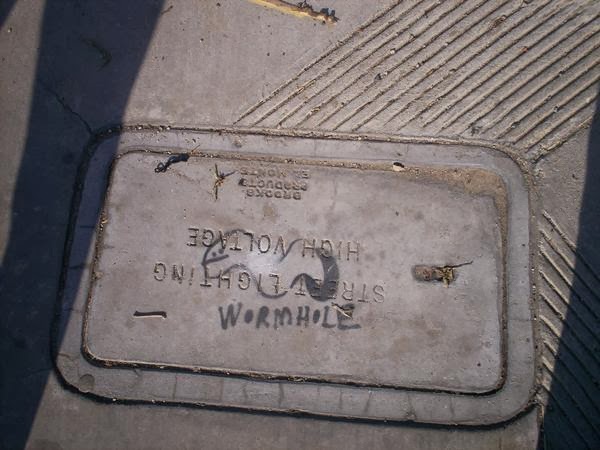
Wormhole in California? I was too chicken to climb in.
(Photo credit: me)

I also believe we could make one if we have the right materials. I have been collecting and experimenting with what I feel are the appropriate materials including:
  • An acai berry
  • Adderall
  • Three physics books
  • Oxyclean
  • Nutella
  • The sequel to Star Wars I wrote when I was eight.
I just have to find a way to spin them fast enough to vaporize them into a homogeneous gaseous substance—I'm thinking about supercharging my dryer (on econo-mode of course). It just...something seems to be missing from the mix.

If only I could find a unicorn hair.

Blog off.
Enhanced by Zemanta

My favorite time machines and what I would do with them

Cover of "Physics of the Impossible
Cover via Amazon
I'm currently reading Michio Kaku's Physics of the Impossible, which discusses the plausibility of ideas proposed by science fiction writers. So far, I am enjoying it as much as Stephen Hawking's A Brief History of Time and Paul Davies' How to Build a Time Machine. So this and several future blog posts will be about how science fiction writers have written the future without realizing it.

Let's start with:

TIME MACHINES

Stephen Hawking said: "I have experimental evidence that time travel is not possible. I gave a party for time-travelers, but I didn't send out the invitations until after the party. I sat there a long time, but no one came."

Some physicists believe it's only ever possible to travel to the future, and the past is set in stone—unchangeable. If we tried to interfere, we would be as ineffective as sandals in a snowstorm. Others believe we could conceivably travel to the past, but the consequences of even the tiniest bit of interference could be catastrophic. I prefer to believe in the Back to the Future version of time travel, which would allow me to travel to the past and through a series of well-intentioned mistakes and a little bit of tomfoolery, make my life even awesomer than it already is. I'd like to believe that at some point in my existence I can travel to the past and erase such bad choices as:
  1. Not going to college immediately after high school, thereby condemning myself to struggle through college in my 30s, while attempting to raise five children and navigate a divorce.
  2. Wishing I spoke another language but not really doing anything about it.
  3. Not investing ALL MY MONEY when I was younger.
  4. Giving up practicing my piano skills because my younger sister was better at it.
  5. Eighties hair.
I'm not obsessed with my past missteps, and wouldn't change it in a big way—no fiddling with the stock market, inventing the Internet first or handing a younger me the pages of The Harry Potter series and trying to convince her she wrote it. I think if I had a time machine, I would do something less world-changing and a little more self-serving, like:
  1. Give 15-year-old me a flat iron with the explicit instruction not to show it to anyone ever (of course 15-year-old me was kind of a brat, so she would totally show all her friends anyway, thereby changing the course of history).
  2. Tell 18-year-old me to stop goofing off. Living in a party house is cool for five minutes, but it will never help you get a better job.
  3. Tell new-mom me that though it's possible something terrible might happen to my children, it's not okay for me to hover over them and make sure nobody ever says anything mean to them. Ever.
(Also, it's okay to let them make mistakes. Also, obsessing about possible fire escape plans for your entire family when you should be sleeping is unhealthy.)

Scientists posit that the tiniest change could have world-changing ramifications. If I choose not to make some of the mistakes I regret, though it may save me some embarrassment and suffering, it could have unintended side effects. Like, you know, maybe Bluetooth would have never been invented or the new Star Trek movies wouldn't have been made. Big stuff like that. So before I go back in time to change these events and uber-awesome my life, I have to step back and consider the potential consequences:
  1. Sadly, straight hair wasn't cool in the 80s. Defying this trend and my hair's natural poofiness could have stunted my educational growth (as I would have been alienated from clubs and extracurricular activities) and would have made me look out of place in my legwarmers and oversized cut-up sweatshirt.
  2. Going to college later in my life meant I took it much more seriously, and though it was rough, I loved everything I learned. Also, my children got to witness my struggles and triumphs, which would later help them through their own collegiate struggles and triumphs.
  3. My children turned out okay, despite my hovering and obsessive midnight theoretical disaster planning. Better than okay. They're amazingly awesome, in fact. 
Now on to the fun stuff. Let's look at some of my favorite time machines from history:

H.G. Wells' Time Machine
(photo credit: National Geographic)

Einstein-Rosen bridge
Einstein-Rosen Bridge
(photo credit: Mr. Barlow's Blog)

The Tardis
The Tardis
(photo credit: Vibrant Oxymoron)
The Flux Capacitor
The Flux Capacitor
(photo credit: Jimsmash)
John Titor
John Titor's Time Machine
(photo credit: LindaJM)
Napoleon Dynamite
Napoleon Dynamite
(photo credit: Brian Terrill)
Next week: How time machines work

Blog off.

Enhanced by Zemanta