How I survived grad school

I haven't posted for a while because I got it in my head that I needed a master's degree. Five minutes later, I started the Master of English program, and have been going nonstop like Xena running the Gauntlet, while working a full-time job and momming a bunch of adult children.

After the myriad requests I received to write new blogs (a couple of people casually mentioning that they hadn't seen anything from me for a while) I decided to take the time to put something out there since now I have the time to put something out there.

About my life over the past two years


First:

It is important to note that the summer semesters cost me (aside from tuition) 30% of my sanity and two toes to frostbite (the latter, while only theoretical, and not actual toes, because the classrooms in the summer are unbelievably cold and like a fool, I was wearing summer-appropriate attire).

Second:

It became somewhat of a tradition for one or more students to follow me out of the classroom on the last day of class to tell me how much they hated me at the beginning of class, but that at some point during the semester realized I was an OK human being. Many of these people I call my friends now, not because I'm so desperate for friends that I'll snuggle up to the mean kids, but because a) these people turned out to be actually cool people, and because, b) hey ... I appreciate the honesty. There's not enough of that.

Third:

I moved more times than I care to admit. Apparently, I have problems committing to living space. I was renting a home when I started the program, because I still had several children living with me, and I decided that when they had all moved out and I had finished the master's program, I would move to Salt Lake City and buy a tiny house or condo that only took 30 minutes to clean to a shine.

Barely into my first semester, the owner came home from whatever he was doing overseas and didn't want to share his home with me and my children, so I moved to a lovely home in the historic district of my town (see photo below of lovely home).

Source: My camera
During my last semester, that owner suddenly, spastically decided that he didn't want to be a landlord anymore, and offered to sell the house to me, but I ultimately declined (based on the advice of an inspector), since, although it's a cool house, it's over 100 years old, and there were some structural issues I wasn't sure I wanted to deal with—also, he was hard-selling it like it was a used car—so I moved into a temporary place while I'm looking for a home to buy. All of my stuff is still in a storage shed because I still haven't found the home I want to live in forever or for the next five or so years.

Also, I realized how much I love the city I live in. Maybe I'm not so eager to leave it anymore.

Fourth:

Hey guys, my laptop died. The. Week. My. Thesis. Was. Due.

I want to make it clear that I recognize there are bigger problems in the world than not having a working laptop. I know with all my heart that my first-world problems are minuscule in comparison with larger, heart-breaking issues.

Source: gamingnexus.com/Images/News/grfoht33307/2.jpg
But the week my 55-page project was due, my laptop died without so much as a whimper, and I was sitting there on the floor, staring at a blank screen in the nest of blankets I'd been sleeping in for the past six weeks because my bed was in the back of a storage shed, AND I was out of wine. It seemed like a pretty big deal in the moment. At the same time, I was laying out and formatting Aelurus, the literary magazine for which I somehow ended up being managing editor. And it was tax season, so every client at my work wanted their tax documents from 7,000 different investment companies. So suddenly, everyone in the world (or so it seemed) was waiting for me to complete things I didn't have access to anymore, and I'd forgotten how to breathe. Between lunches at work and my daughter's 11-inch Asus, which sports a keyboard too small for my life-sized hands, I completed the project, finished laying out Aelurus, and remembered how to breathe. The night I turned my project in, I drank some (too much) celebratory wine and played Peggle (badly) with my two youngest children.

I received my degree (empty purple cover) at a hooding ceremony on a Wednesday night. My family and some close friends attended, including a professor who isn't in my department, but taught a couple of my graduate classes (and whom I have become good friends with over the last two years), and a professor who taught a few of my undergrad classes years and years ago, and has since retired. I felt honored to have these people (professors, family, and friends) take time out of their schedules to sit through this ceremony with me.

The highlights of my time in the programs were meeting those fellow students I hope will remain my friends for years to come, and meeting those amazing professors I also hope will remain my friends for years to come. Yes, I improved my writing skills and got a paper accepted to a conference in New York. But basically, I met cool people and wrote cool stuff, including:
  • an essay on how humans refused to stop exploring once they ran out of untamed terra firma, so they dug into the human mind, and ventured out to space
  • an essay on how strong women in pop culture tend to be highly sexualized instead of intellectualized
  • a series of feminist poems and essays with a backbone of modernized mythology
To sum up, it was a rough couple of years, but it was an amazing couple of years. I'd do it again with less relocating and more laptop.

What I'm doing next

Nothing different. I'll keep working the same job, continue to look for a house, and relish the time I have to hang out with my children and the friends who stuck with me through the two years during which I virtually disappeared.

For my friends still in the program—I love you, I miss you, I'll see you on the other side.


Time Machines: Part Two

Last week I talked about some time machines from science fiction and what I would do if I had access to one. Today I'll discuss how likely they are to get me to my time-travelling goals. I've compiled a list based on my own limited knowledge of physics (two college courses and abuncha books). This list is not designed to incur the wrath of Stephen Hawking (who possibly reads my blog), Bill Nye the Science Guy, or Sheldon from The Big Bang Theory. However, if after reading this blog you disagree with me, you should feel free to tell me so in the comments section as long as you post as one of the aforementioned.

That being said, the list below is ranked on probability (as I understand it) in order from least to most likely:

6. The time machine from Napoleon Dynamite: I loved this time machine because it was ridiculously simple, and you can get it online (theoretically). However it didn't work—not even in the movie, so I'm rating it as the least likely time machine to work as intended and the most likely time machine to shock your junk in a non-sexy way.
Time Machine from Napoleon Dynamite
(photo credit: Emergiblog)

5. H.G. Wells' time machine: It's been a while since I read this book, but as I remember it, this machine was designed to arrive at the same point in space, regardless of the time. Perhaps H.G. forgot to take the movement of the planet into consideration and his unsuspecting time traveler should have materialized somewhere out in space, albeit in a different time, attempting to shout "Eureka" in a vacuum for 30-60 seconds until his fluids boiled. Although this would allow me to time travel, I don't believe I would have enough time to affect any significant change before I ceased to exist.
H.G. Well's Time Machine
(photo credit: IGN)

4.The flux capacitor: I have no evidence that this machine works, except that Doc Brown said it did, but I've provided a link to a website that explains it for those of you who are curious. Still, it seems like the classiest of all the time machines—as it is housed in a DeLorean.
The Flux Capacitor
(photo credit: Futurepedia)

3. John Titor's time machine: I've rated this one of the more likely to work, simply because I'd really like to believe that some guy traveled back in time and spent his time posting on message boards about the future and was obliging enough to include the schematics of this time machine. John Titor no longer posts online, either because he went back to the future, or he was really a pimply-faced kid who grew up and got tired of his wife yelling at him every time he tried to post. ("I'm not looking at porn, Angela. I'm preserving the world for our children. (Side note: I've decided that his wife's name is probably Angela.)) Sure, I know his posts didn't come true exactly the way he said they would, but that's because in telling us, he created a paradox, which a) altered the future or b) split us off into an alternate timeline. But then you knew that already, didn't you, John?
John Titor's Time Machine Schematics
(photo credit: Stranger Dimensions)

2. The Tardis: I had to put this second-to-last because it technically uses wormhole technology. Also...it's bigger on the inside, which allows its occupants to enjoy a nice swim as they're bopping about in time. It's the second most probable, because I think anything you chuck into a wormhole is going to get you where you need to go, but hey...why not do it in an 1963 police call box?
TARDIS Mk VII
TARDIS Mk VII (Photo credit: Rooners Toy Photography)

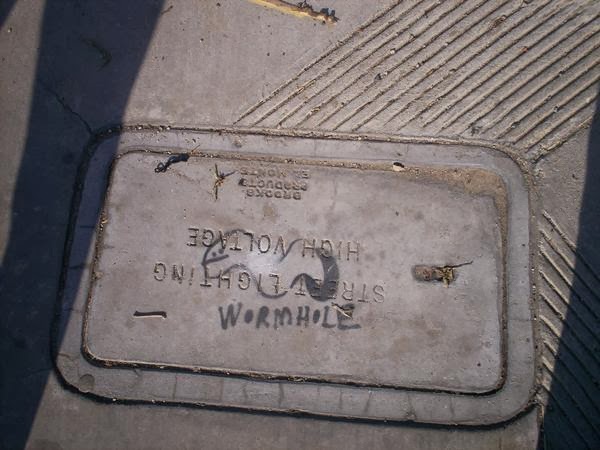
1. Einstein-Rosen bridge: I rated this as the most probable, because I believe that wormholes exist already in outer space and possibly under sinks in Norway, I just haven't found one yet—although this looks legit.
Wormhole in California? I was too chicken to climb in.
(Photo credit: me)

I also believe we could make one if we have the right materials. I have been collecting and experimenting with what I feel are the appropriate materials including:
  • An acai berry
  • Adderall
  • Three physics books
  • Oxyclean
  • Nutella
  • The sequel to Star Wars I wrote when I was eight.
I just have to find a way to spin them fast enough to vaporize them into a homogeneous gaseous substance—I'm thinking about supercharging my dryer (on econo-mode of course). It just...something seems to be missing from the mix.

If only I could find a unicorn hair.

Blog off.
Enhanced by Zemanta

My favorite time machines and what I would do with them

Cover of "Physics of the Impossible
Cover via Amazon
I'm currently reading Michio Kaku's Physics of the Impossible, which discusses the plausibility of ideas proposed by science fiction writers. So far, I am enjoying it as much as Stephen Hawking's A Brief History of Time and Paul Davies' How to Build a Time Machine. So this and several future blog posts will be about how science fiction writers have written the future without realizing it.

Let's start with:

TIME MACHINES

Stephen Hawking said: "I have experimental evidence that time travel is not possible. I gave a party for time-travelers, but I didn't send out the invitations until after the party. I sat there a long time, but no one came."

Some physicists believe it's only ever possible to travel to the future, and the past is set in stone—unchangeable. If we tried to interfere, we would be as ineffective as sandals in a snowstorm. Others believe we could conceivably travel to the past, but the consequences of even the tiniest bit of interference could be catastrophic. I prefer to believe in the Back to the Future version of time travel, which would allow me to travel to the past and through a series of well-intentioned mistakes and a little bit of tomfoolery, make my life even awesomer than it already is. I'd like to believe that at some point in my existence I can travel to the past and erase such bad choices as:
  1. Not going to college immediately after high school, thereby condemning myself to struggle through college in my 30s, while attempting to raise five children and navigate a divorce.
  2. Wishing I spoke another language but not really doing anything about it.
  3. Not investing ALL MY MONEY when I was younger.
  4. Giving up practicing my piano skills because my younger sister was better at it.
  5. Eighties hair.
I'm not obsessed with my past missteps, and wouldn't change it in a big way—no fiddling with the stock market, inventing the Internet first or handing a younger me the pages of The Harry Potter series and trying to convince her she wrote it. I think if I had a time machine, I would do something less world-changing and a little more self-serving, like:
  1. Give 15-year-old me a flat iron with the explicit instruction not to show it to anyone ever (of course 15-year-old me was kind of a brat, so she would totally show all her friends anyway, thereby changing the course of history).
  2. Tell 18-year-old me to stop goofing off. Living in a party house is cool for five minutes, but it will never help you get a better job.
  3. Tell new-mom me that though it's possible something terrible might happen to my children, it's not okay for me to hover over them and make sure nobody ever says anything mean to them. Ever.
(Also, it's okay to let them make mistakes. Also, obsessing about possible fire escape plans for your entire family when you should be sleeping is unhealthy.)

Scientists posit that the tiniest change could have world-changing ramifications. If I choose not to make some of the mistakes I regret, though it may save me some embarrassment and suffering, it could have unintended side effects. Like, you know, maybe Bluetooth would have never been invented or the new Star Trek movies wouldn't have been made. Big stuff like that. So before I go back in time to change these events and uber-awesome my life, I have to step back and consider the potential consequences:
  1. Sadly, straight hair wasn't cool in the 80s. Defying this trend and my hair's natural poofiness could have stunted my educational growth (as I would have been alienated from clubs and extracurricular activities) and would have made me look out of place in my legwarmers and oversized cut-up sweatshirt.
  2. Going to college later in my life meant I took it much more seriously, and though it was rough, I loved everything I learned. Also, my children got to witness my struggles and triumphs, which would later help them through their own collegiate struggles and triumphs.
  3. My children turned out okay, despite my hovering and obsessive midnight theoretical disaster planning. Better than okay. They're amazingly awesome, in fact. 
Now on to the fun stuff. Let's look at some of my favorite time machines from history:

H.G. Wells' Time Machine
(photo credit: National Geographic)

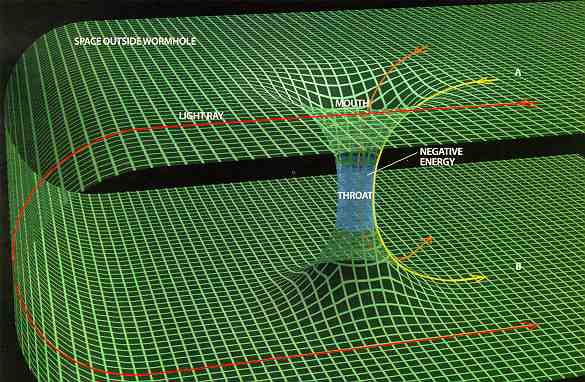
Einstein-Rosen bridge
Einstein-Rosen Bridge
(photo credit: Mr. Barlow's Blog)

The Tardis
The Tardis
(photo credit: Vibrant Oxymoron)
The Flux Capacitor
The Flux Capacitor
(photo credit: Jimsmash)
John Titor
John Titor's Time Machine
(photo credit: LindaJM)
Napoleon Dynamite
Napoleon Dynamite
(photo credit: Brian Terrill)
Next week: How time machines work

Blog off.

Enhanced by Zemanta

Watch, Read, Live, Love

A Renaissance manuscript Latin translation of ...
A Renaissance manuscript Latin translation of The Republic
(Photo credit: Wikipedia)
I just finished reading Plato's The Republic. As I was finishing it, I happened to be sitting across from a kid on Frontrunner who was ALSO READING Plato's The Republic. This prompted him to start a conversation, in which he tried to either sympathize with women, or pick a fight with me. I couldn't tell. He said his favorite part of the book was where Plato advocated the education of women, but it was unfortunate that Plato also claimed they were inferior in every way. I just smiled and told him I was glad he was enjoying the book.

It's funny how strangers can bond over a book. There are forums online where strangers form relationships based on their mutual love of The Harry Potter series, LOTR, and The Twilight Series. Unfortunately, like clubs, political parties, sports teams and religions, it can also create a strong divide.

Some people get unbelievably pissed off when you don't like what they like or believe what they believe. This seems to be a case of intense egocentrism—my way of thinking is the only way of thinking. The obvious case is religion. We don't need to get into that, but child-rearing, book and movie preferences—that's what baffles me.

Years ago, my neighbor asked me if I spanked my children. When I told her that instead, I used time out and other less physical methods, she coldly told me that she spanked her children and that was the only way to effectively discipline them. We never really spoke after that and she stopped letting her children play with my children—like they had the no-spanking disease she was afraid her children would catch. She had asked me a question, not because she really wanted to know the answer, but because she wanted me to confirm that she had made the right parenting decision.

I've been blacklisted for not loving crude humor comedies like Dumb and Dumber and Anchorman. I've been snark-eyed for electing not to read Fifty Shades of Grey or for not loving (or even liking) the Twilight Series.

This morning, I sat across from a 20-something, who was wearing yellow skinny jeans and a scarf. He was alternating between reading a novella and sleeping. Behind him sat a woman, almost completely covered in black cloth, her eyes barely peeking through the material as they scanned her laptop screen. Across from her sat another 20-something wearing a collared shirt and khakis, watching Super Bowl commercials on his iPhone. Behind him, and across from me, sat a woman in her 40s, wearing a bright floral dress, engrossed in a romance novel. I formed the fourth corner of we-come-from-different-places square in my hybrid outfit of office clothes, comfy leggings and scuffed-up boots for the commute, carefully navigating a much-loved copy of Graham Swift's Waterland. We all read or watched what we were reading or watching and got off the train when we were at the appropriate stop. Nothing terrible happened.

The point is, that it doesn't make sense to feel anger towards someone who didn't like Cormac McCarthy's The Road or Suzanne Collins' The Hunger Games Series. Instead of immediately writing off people whose opinions and experiences differ from ours, it would make more sense to listen without judgment to their views. You can agree or not agree, but just maybe you'll expand your horizons a little—I don't mean change your mind even, just understand a different way of seeing the world.

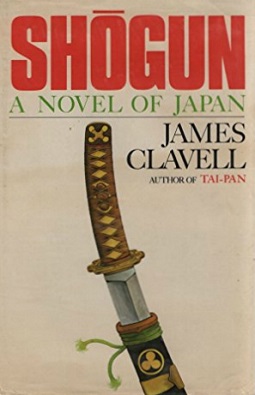
Shōgun
Enter Shōgun by James Clavell—Englishman-meets-Japanese culture. The Englishman thinks the Japanese are barbarians for their tradition of seppuku and sexual diversity. The Japanese think the Englishman is a barbarian for his poor hygiene and food-preparation techniques. Ultimately (a thousand pages later) they come to a mutual understanding, and even respect for each other's culture. They come to understand that there is tradition and belief behind the "barbarism."

See what I did there? We're all just people who have been somewhere, trying to get somewhere with whatever tools and knowledge we have available.

Watch. Read. Live. Love.

Blog off.

Enhanced by Zemanta

How Erin Morgenstern broke my heart

What books look
like to me now
(Photo credit:
Open Letters Monthly)
I am in a crisis. As mentioned in my last post, I recently read The Night Circus by Erin Morgenstern and now I can't seem to read anything else. I tried reading Troilus and Cressida, but really struggled with it—not because it's not my kind of story. It's totally my kind of story. Before The Night Circus, I had just finished Electra, I've read Iphigenia, The Iliad, The Odyssey and The Aeneid—but because Troilus and Cressida didn't flow as well as The Night Circus. Did you hear that Shakespeare?

Well, Cynthia, I said to myself, stop crying about it and try reading something more contemporary—something maybe that flows better. So I tried reading The Conservation of Shadows by Yoon Ha Lee, which I bought because I read the Top 14 Books of 2013 upside down and thought it was #1. Hey, I never claimed to be a numbers wiz. Anyway, I'm only 5% of the way through the book and the author has already used "obdurate" twice. I can't. I just can't.

Here is my dilemma. I like to write science fiction, but I mostly can't stand reading it,  because sci-fi writers tend to try and incorporate everything they ever learned about physics, chemistry, biology, geology or any other kind of -ology or -ics into their stories. Still, there are still some sci-fi authors I love.
Part of my problem is that my favorite sci-fi authors are no longer with us, confounding my dreams of having a neverending flow of interesting, funny or beautiful books to read.

Most other sci-fi books are filled with characters with unpronounceable names that have either excessive consonants or vowels. Sometimes it's just the noise you make in the back of your throat as you swallow. There's so much weirdness and alieninity (I made up a word 'cause I can), it's hard to follow the protagonist through their way-too-alien world, which is way too alien because authors want to do something completely different from anything that's ever been done before. Well, hey. Different has been done. Try not being lame. That's different.

Back to my initial rant. Erin Morgenstern's book is not sci-fi. Its fantasy. I don't normally read fantasy unless it's written by C.S. Lewis or J.R.R. Tolkein, because it tends to be even more overblown than sci-fi, but this one I loved. The biggest problem is that Erin Morgenstern has published exactly. One. Book. So I can't even read anything else of hers yet to help ease my pain.

Blog off.
Enhanced by Zemanta

Of queries and circuses

The Night Circus by Erin Morgenstern
(photo credit: Wikipedia)
Again with the synopsis. That dirty, dirty nightmare of a word. No one really gets excited when you say synopsis—not fiction writers, college students or, I'm guessing, agents and publishers, since they have to muddle through myriad half-hearted, but well-meaning attempts at boiling a 100,000-word manuscript down to a few pages.

But as annoying as they may be, synopses are important for a few reasons:
  • They help writers focus their plot lines.
  • They are an effective way for the agent/publisher to see if aforementioned writer knows how to tell a story without having to slosh through hundreds of pages to find out.
  • They are great practice for concise writing.
Every writer should want to write a synopsis for every manuscript. And they should do it before they send out their first query letter. Many writers get ahead of themselves and dash off a query letter while they're still editing. This is like auditioning for X Factor after your third voice lesson. If you want to be taken seriously, you won't waste your time and the agent's/editor's. This is how your query checklist should look.
  1. Write manuscript--it seems obvious, but sometimes people try to skip over this step.
  2. Edit manuscript at least twice--no matter how awesome you think it is on the first try.
  3. Let a dozen beta readers read the manuscript and consider their suggestions/comments--you don't have to use all of them, but if five people are telling  you the same thing, maybe you should listen.
  4. Edit manuscript again--until everything flows.
  5. Write query letter--one page to really sell your story.
  6. Edit query letter at least twice--no matter how awesome you think it is on the first try.
  7. Let at least one beta reader read the query letter and consider his/her suggestions/comments--are they dying to read your manuscript based on the query?
  8. Edit query letter again--until everything flows.
  9. Write synopsis--summarize each chapter and condense and hone.
  10. Edit synopsis at least twice--no matter how awesome you think it is on the first try.
  11. Let at least one beta reader read the synopsis and consider his/her suggestions/comments--but only choose the people you don't mind spoiling your story for. The synopsis should include the ending.
  12. Edit synopsis again--until everything flows.
  13. Research agent/publisher--what genres do they represent? What books/authors do they represent?
  14. Make sure your manuscript fits agent/publisher criteria/book list--you're wasting your time and theirs if it doesn't.
  15. Send query letter according to agent/publisher guidelines--they love it when you do this. It's like candy in a rainstorm.
That's right. There are (at least) 15 steps you should take before you send out a query letter. Most importantly, your manuscript should be finished, unless you are pitching a concept, and by the agent's/publisher's guidelines it is okay to do so.Only slightly less important, is the targeted query. It's important for the prospective agent/editor to know they are more than a whim or afterthought. You should know who they are, what kinds of books they represent and which books, specifically, they represent.

I was recently involved in the hiring process for a job that opened up in my company. I got cover letters that were obviously not intended for the job we were looking to fill, and one very unprofessional phone message, during which, the caller forgot a) who she was calling b) which job she was calling about. There was a long, awkward pause while she searched through a pile of papers for the information and ultimately, she named the wrong job. I immediately shredded her resume, and agents and editors will do the same if you send a half-assed query letter. It's about quality, not quantity. It's not how many agents/editors you can annoy, it's about finding the one who's a fit for you and your story.

That's my rant. In other exciting news, I finished reading The Night Circus by Erin Morgenstern last night. It was one of the most beautifully-written books I've ever read. You should read it. Everyone should read it. When they make it into a movie, I'll watch the hell out of it, but it won't be as good as the book.

Blog off.
Enhanced by Zemanta

Of tomes and transportation

Cover of "Anna Karenina"
Cover of Anna Karenina 
(Barnes & Noble Classics)
I am long overdue for a new post, so here it is. I hope it was worth waiting for. The end of 2013 was busy for me, what with NaNoWriMo (success!), the holidays and my daughter coming home for a visit. That being said, I've discovered something amazing—something that has helped me reclaim precious hours every weekday.

Public. Transportation.

I know, I know. Some of you are shaking your heads and gagging a little. You think public transportation is for homeless people and people who have lost their driver licenses, but swallow your vomit and listen: I commute for an hour each week day to and from work. Normally, that consists of me stumbling (or sliding, depending on the weather) down my front steps, chucking my purse into my car, while balancing (sometimes failing to balance) a coffee mug and white-knuckling it to work, trying to find a good song on the radio, or belting out half-remembered lyrics to a karaoke CD. I have been known to listen to an audio book on the way, but they're either expensive, or narrated by a British octogenarian with an ultrasonic, crackly voice (e.g. The Aeneid from the public library).
Cover of "The Book Thief"
Cover of The Book Thief

Enter the commuter train. It's far from perfect. Sometimes the temperature is low in the morning—like in the ones of degrees. Instead of getting in my car and cranking up the heater until I'm toasty, I make a quick drive to the station, tromp through the snow and ice and find a seat that doesn't smell like wet dog. Today a female commute was loudly upset that I sat in her usual seat. Also, it's not acceptable for me to sing at the top of my lungs. But the upside is that after that point, I get to read for AN HOUR. And then again on the trip home. That's two hours of reading a day, people—two hours I didn't get before. It's like a snow-soaked miracle.

Although I've had to deal with some awkward public transit moments—the guy across from me wet-coughing into my face or the lady next to me telling random fellow travelers a story for the fifth time in as many days—I get to read. In the six weeks that I've been taking the train, I've read six books, including:
Cover of Divergent
(Photo credit:.
Veronica Roth Books)

Anna Karenina - Leo Tolstoy
The Book Thief - Markus Zusak
Divergent - Veronica Roth
Gone Girl - Gillian Flynn
The Picture of Dorian Gray - Oscar Wilde
Electra - Sophocles

Some of you will understand how amazing this is—to find two extra hours a day to read. And I can read on almost anything. I have a Nook, which was a Christmas gifts from a friend a couple of years ago (thanks friend!) on which I have 60+ e-books—many of which were free, because they are the classics, including The Picture of Dorian Grey and Electra. When I forget to charge my Nook, I can use the Nook app on my phone to access said e-books. I also have a Kindle app on my phone, and Goodreads has some e-books available. I'm currently reading The Lost World by Sir Arthur Conan Doyle on Goodreads. When all else fails, I have real-life, hold-in-your-hand, turn-the-page-with-a-lick-and-a-swish books to read.

Gone Girl by Gillian Flynn
(Photo credit: bubbletea1)
When I get home, instead of feeling angry and defeated—hyper aware that the world is filled with bad people who text and apply makeup while driving or must get in front of you at all costs, I can experience other emotions. Sometimes the other riders get to experience them with me, especially when I'm reading the last few pages of The Book Thief. (Sorry, guy who tried not to notice the tears quivering off my chin.)

What does this have to do with writing? Everything. Reading has everything to do with writing. Reading has everything to do with everything. Reading gives you a better vocabulary, enhances critical thinking, reduces stress and improves memory, discipline and concentration. It also heightens your emotional intelligence. I've read so much lately, I'm an EQ superhero who knows what you're thinking right now. I don't even need to see your face. For more information on how reading can make you superhuman, see this article on The 26 Major Advantages to Reading More Books and Why 3 in 4 People Are Being Shut Out of Success and this article on What Reading Does for the Mind.

The Picture of Dorian Gray
(Photo credit:
Ben Templesmith)
That's right. So because I'm reading more, I'm inspired to write more. And because I'm writing more, I'm inspired (required) to edit more. And I have plenty to edit. Three NaNoWriMo manuscripts lay waiting for me to tackle them and two "finished" novels are waiting for me to fine-tune and query their word-filled pages.

Partly due to my aforementioned discovery, I expect this year to be filled with reading, writing, coffee and awesome.

Happy 2014 everyone.

Blog off.
Enhanced by Zemanta